Happiness doesn't run after anyone, you have to seek it out. -Kolping-
With this menu item I would like to introduce you to the country of Croatia as well as the place of my contemplative year (2014) in Porec.
Croatia has around 3.8 million inhabitants and its capital is Zagreb. The still young European state gained its independence from the former Yugoslavia in 1991. The largest ethnic group is Croatian (approx. 95%), who are predominantly Roman Catholic. There is a lot to experience and explore in Croatia. In summary, the country has changed and modernized its infrastructure several times since its independence.
The most important tourist parts of the country are primarily the Adriatic coast. Starting with Istria, due to its easy accessibility from Bavaria, and especially the Dalmatian coast with the tourist superhighlight Dubrovnik. Fans of hearty/meaty food (so-called: Schmackofatz) will get their money's worth in Croatia with the gigantic meat platters. But good fish and, above all, haute cuisine have also found their home in Croatia (many Michelin Guide restaurants).
Insider tip: The Croatian hinterland from Osijek (Baranja / Slavonia) is becoming more and more touristy & a trip there (wines and very tasty hearty food) is worthwhile.
Dzimi's tip: Fish paprikash
This video from the British BBC presents real Croatian „Schmackofatz“, primarily in the region of Slavonia / Baranja. This region is outstanding for lovers of hearty meat in all variations with a calmness from crowds. By the way: there's a bit of alcohol in the video 😉 (Cheers!)
Croatia has a diaspora scattered around the world, mainly in the following countries: Germany, Austria, Switzerland, North America, Australia and South America. The reasons for this negative migration over the last hundred years have mainly been political - due to the shortage economy of the imposed economic system (planned economy).
Croatia's economic trend (prosperity) is progressive. Croatia has been part of the European Union since 2013 & has introduced the euro currency in 2023. Membership of the OECD is imminent. Croatia's credit rating as of February 2026 is a solid A- (formerly BBB-, approx. 2010).
The figurehead of the new Croatian economy is an example:
RIMAC -> Croatian super sports car manufacturer
The inventor & company founder Mate Rimac lived in Frankfurt / Main (Germany) during his youth.
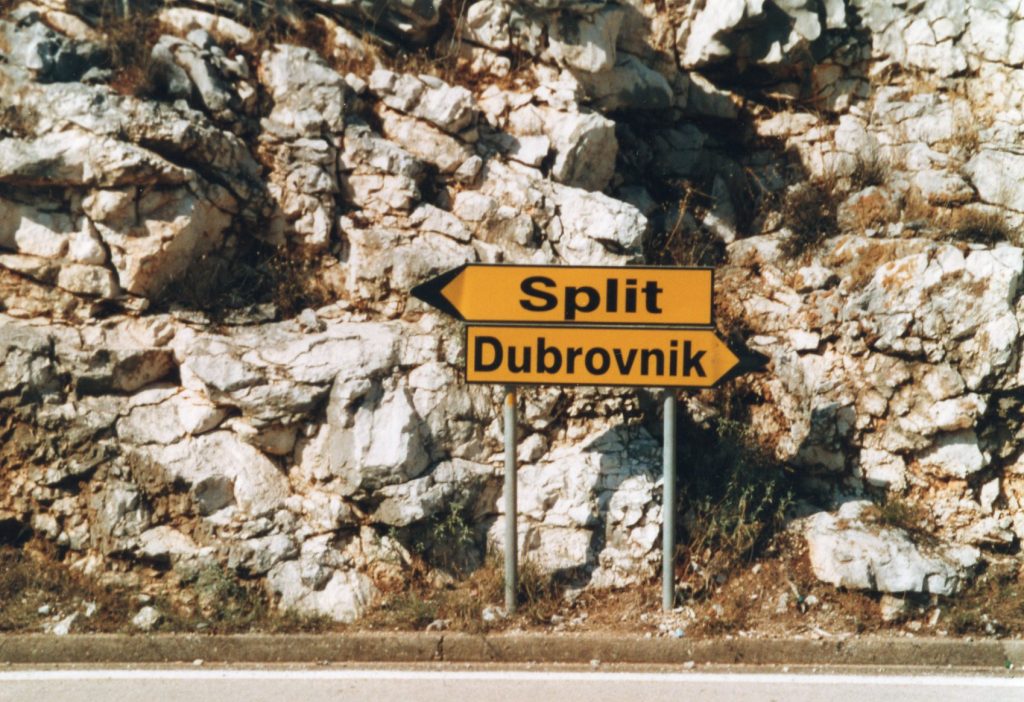
Signposting along one of the most beautiful coastal roads (over 500 km) in the world: the Croatian Magistrale. ...a dream of villages!
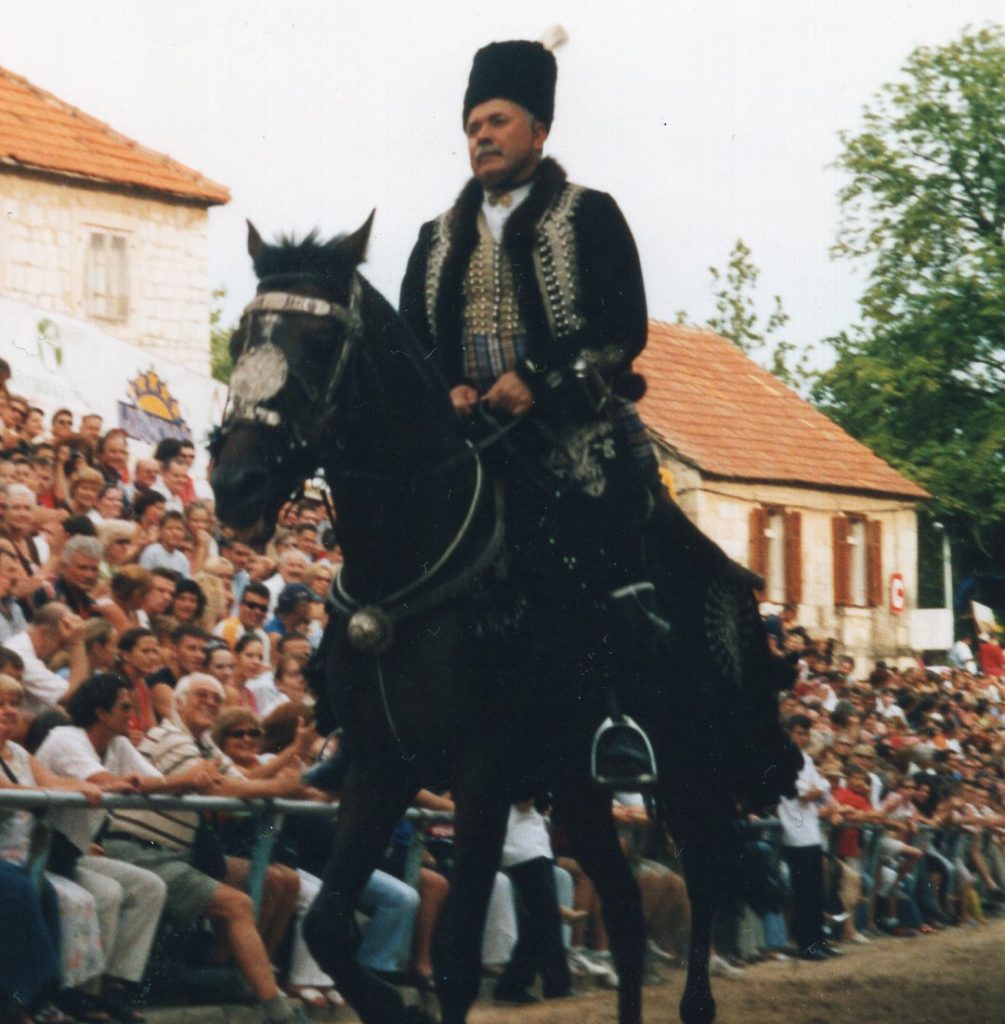
Croatian knights„ festival “Sinjske Alka" (own photo; ca. 2003) with a lancer in the photo. The spectacular games originated as thanksgiving for an apparition of the Virgin Mary (1715) on the side of the victorious Croatian troops in an enemy battle at the time. The annual games have been a UNESCO World Heritage Site since 2010.

Beach promenade in Porec with the passing towards Euphrasius Basilica.
...this is what someone (Dzimi) looks like on vacation on the beach promenade of Porec! 😉
Porec is a tourist town on the Croatian Adriatic coast in the Istria region (peninsula). It is less than 30 minutes by car to Slovenia and another 20 minutes to Italy (Trieste). There is also a regular tourist ferry connection to Venice (Italy).
The church tower of the basilica in sight, after the walk along the promenade
The Euphrasian Basilica as a building complex from the viewpoint of the beach promenade in Porec
The atrium of the church in Porec
Another view of the church tower of the basilica
View from the right aisle of the basilica towards the altar with a view of the statue of the Virgin Mary
Basilica statue of the Virgin Mary with beautiful ceiling mosaic (ca. 2023)
View of the altar in the center of the nave
What you think is an obstacle now will be an effective remedy later. - Vincenz Ferrer -
View into the side chapel of the Euphrasian Basilica. The part of the church where the morning rosary takes place, followed by Holy Mass and then Eucharistic adoration.
In the beginning, I was present as a visitor sporadically throughout the week, in the back pews. As the weeks went by, I moved from the back pews to the front during prayers -> and worked my way (prayers) to the pews of the local visitors! 😉
Another closer look at the altar area with the statue of Joseph (left) and the statue of the Virgin Mary (right), with the altar and Jesus cross in the center. The golden image (top right) is of the blessed priest Miroslav Bulešić.
View of the expanded port facilities of Porec and the Adriatic Sea as an exit (2023)
The train station in Pula with my father (Tadija) in a red polo shirt
...such an elegantly decorated station (flowers) -> The train is coming! 😉
...such a great panorama at the station 🙂
Church in Vinkovci, Croatia (Slavonia region)
Interior of the beautiful church in Croatia with beautiful flowers and general decoration
Right next to the church above is the town's most important square, named after my namesake: Baron Josip Sokcevic (Josef Sokcevic KuK)
City center with cafés
The last lighthouse keepers of Croatia -> Who isn't looking for a job full of silence like this? 😉
In my opinion, the aerial shots using drones and the ambience captured are very successful. The documentary is very lovingly created because of the many personal passages of the actors.
In German and French (sound) online.
The video clip below by the Croatian singer and songwriter Škoro is one of my favorite pieces of Croatian music. The artist always has very beautiful, apt, homeland-loving songs with references to the past and a view to the future. But also, above all, the critical examination of the socialist regime in the days of Yugoslavia and its aftermath.
In Croatia they literally say: „Domoljubne Pjesme“ in German: Homeland-loving songs.
„Heroji ne plaču“ - Heroes don't cry! The core of the song sings about the sacrifice of soldiers and the emotional pain that accompanies them until the end of their lives.
The above video is a documentary summary of Operation Maslenica (Olive Tree) which aimed to break the Serbian pincer barrier between the southern part of Croatia in Zadar and the northern part of Croatia. It was one of the major turning points of the Croatian War of Independence against the Serbian aggressor in 1993. The Croatian army successfully completed this military operation. Maslenica was the beginning of the end of the Croatian war, which ended in the victorious defense (recapture of the Serb-occupied territories on regular Croatian soil), with the military operation: Storm (Oluja), in 1995!
Origin of my parents:
My parents, father Tadija & mother Ruža, originally come from the former Yugoslavian republic of Bosnia & Herzegovina. In the 1970s they both immigrated to Germany, Hesse, after getting married.
Both my parents, my grandparents, were farmers and self-sufficient (they slaughtered their own organic pigs - so called: wild pigs! 😉 )
However, my grandfathers also had to endure a number of lean periods in Yugoslavia and had to earn extra money for many years in Germany, Babenhausen (paternal grandfather) or in Austria, Vienna (maternal grandfather), leaving their families behind for weeks and months on the farm over the years.
Grandfather's father worked in road construction and grandfather's mother was a carpenter!
The origin (places) of my parents until 1991 (secession wars in Yugoslavia).
Bosnia & Herzegovina
Location: Turić, Tadija (father)
Place: Blaževac, Ruža (mother)
The village disco was in Pelagićevo where my parents met while dancing 😉.
In both villages, our properties were completely cleared out and then gutted down to the walls (even the copper cables were taken). My grandparents fled to Croatia in the last few days before the villages fell to the Serbian units. My mother's parents went to Osijek / Josipovac and my grandfather on my father's side to Privlaka (Croatia / Slavonia) to their second estates.
From then on, we all realized that it would no longer be possible to return to the houses we had saved up and built in the diaspora (D, A, CH).
We only saw our future as Croats in Bosnia in Croatia!
The above video by the Croatian artist Tajči with the song: Hajde da Ludujemo English: Let's Party! Was the last Yugoslavian song for Eurovision 1990, in Zagreb, then Yugoslavia.
The state then broke apart and ended in the Yugoslavian war.
The singer Tatiana Cameron (Tajči) is just 20 years old in the video. The song is sung live.
The show and the stage interludes are still classic for me personally to this day, as are the clothes - the singer is just huggable.
The singer is now active in the church sector, especially in the USA, rather than in pop music.
The above soccer match (short documentary-HRT) heralded the final end of Yugoslavia in the minds of the people of the multi-ethnic state (May 13, 1990).
Dinamo-Zagreb played against Red Star Belgrade in Zagreb (Maksimir Stadium). Already the day before, several fans of Red Star Belgrade traveled to Zagreb and chanted Serbian nationalist slogans in Yugoslavia / Zagreb as well as demolished several objects such as the streetcars.
The two soccer clubs and their fans, who have always been rivals, then settled a number of outstanding nationalist scores in the Zagreb stadium.
The match could not be kicked off due to the violent excesses of both fan groups. The security forces in the stadium provided more passive cover for the Red Star Belgrade fans. In the scene, a Croatian fan of Dinamo-Zagreb was beaten up with truncheons by a Yugoslav police officer. The Croatian star player Zvonimir Boban rushed & protected the Croatian fan from the Yugoslav policeman's truncheon blows by knocking the policeman over with a sidekick (minute 1:48).
This symbolic revolt by the Croatian Zvonimir Boban against the communist regime, which was represented by the police, was the trigger for a rethink, especially among the Croatian population, as to whether it really made sense to remain under such a state with Serbian hegemony.
The independent Croatian state began to take shape!
Reflection of the events on the present day:
I (Dzimi) can't describe any bad experiences with Serbian people. I visited Belgrade (around 2014) as an example and was always warmly welcomed. I got my second job (2016) from a German of Serbian descent (first name: Dušan, by the way: Hvala! 🙂 ). I've had several Serbian colleagues at work and I still have them today.
I would put it down to the great power politics of Slobodan Milošević at the time that the state of Yugoslavia disintegrated under war.
I have not studied politics, but it is very difficult to reconcile so many peoples (e.g. Yugoslavia) politically and economically (strong geographical differences in prosperity).
I wish the region lasting peace and much more international understanding!
You can also experience a lot in Bosnia: For example, Sarajevo (1984 Winter Olympics), Mostar, etc. On the country roads in Bosnia you can get delicious hearty Schmackofatz (grilled lamb or roast suckling pig).
By the way: Bosnian people can be very funny and usually have a deeply black sense of humor! 😉
During the Bosnian War (1992-1995), the capital Sarajevo was besieged by Serbian units, logistically supported by the former JNA. JNA. Important and urgently needed medical supplies could more or less only be brought to Sarajevo via airlift. The city was surrounded. From then on, the city was supplied from Ancona in Italy by German, British, French and US-American as well as Canadian aircraft.
The final approach to landing began at an altitude of approx. 6,000 m in order to avoid the range of small arms fire.
In private flying (dives, sideways glides (SLIP), steep turns, parabolas etc.) it's great fun (to test the forces at work and the limits of the aircraft).
🙂
From then on, such a fall-landing approach was and is called the „Sarajevo approach“!
The Croatian Mirko Novosel is my personal superhero! Not because I am an outstanding basketball enthusiast/player, but because I like the inconspicuous aura of coach Novosel so much. He once said in an interview for Croatian television: „When I entered the entrance door of the basketball hall, everyone knew where their place was.“
Novosel was able to motivate people intrinsically ;-), like a world champion! Despite basketball giants like the USSR or the USA at the time, he won medals and victories!
-> That's what I call positive leadership!
February 2026